ONE OF AMERICA’S MOST UNUSUAL and remote national parks, Dry Tortugas National Park is located 68 miles west of Key West, Florida, in the Gulf of Mexico. Though it encompasses 101 square miles, more than 99 percent of the park surface area is actually the waters of the Gulf of Mexico. Seven tiny islands (or six or five, depending on wave action, tides, and hurricane activity) make up the park’s land area. Just getting to the park provides visitors with a feeling of accomplishment: The only way to reach it is by boat or seaplane.
The post Dry Tortugas National Park appeared first on MapsofWorld USA.
]]>So what’s the attraction? Crystal-clear water abounding in healthy coral reefs and marine life, for one thing. Vast flocks of seabirds in nesting season, spring and fall, for another.
Most significant, though, is Fort Jefferson, the largest all-masonry fort in the United States. The 19thcentury fortification rises on one of the park’s tiny islands, Garden Key, and stands as an awe-inspiring example of sweeping military architecture. Its history is as unique as its glorious mid-water setting.
Tortugas is Spanish for “turtles.” Spanish explorer Juan Ponce de León came upon these specks of land in 1513 as he was sailing around Florida. He named them for the sea turtles found in the gulf. Sailors, including pirates, used the turtles as food and also took huge quantities of eggs from colonies of terns and other birds. The word “dry” was added to the name as a warning to sailors running low on freshwater that they would find none hereabouts.
The United States took control of the Dry Tortugas when it acquired Florida from Spain in 1822. A lighthouse was built on Garden Key, the largest of the islands, in 1825, to guide ships through the maze of reefs and shoals. (A taller lighthouse was constructed on nearby Loggerhead Key in 1858.) In 1846, the U.S. government began construction of a fort on Garden Key, intending it as a base from which to control ships trying to enter the Gulf of Mexico.
The fort was huge, with room for 1,500 soldiers and the capability to withstand a one-year siege. Construction continued through the Civil War until the U.S. Army abandoned the fort in 1874. Though some 16 million bricks had been assembled for its formidable walls, the fort was never officially finished. Despite its eight-foot-thick walls and sheer sweeping proportions, it had been made vulnerable by advances in artillery.
In addition, the structure had settled into the fine sand more than had been expected, and there were fears that adding more bricks and heavy cannons would cause the mammoth structure to sink.
Was all the effort wasted? Not really. Even though its cannons never fired a shot in conflict, its mere presence helped prevent foreign aggression.
During the Civil War and for nearly a decade after, Fort Jefferson served as a military prison. Its most famous prisoner was Dr. Samuel Mudd, who set the broken leg of John Wilkes Booth, the assassin of President Abraham Lincoln.
Although Mudd said he had no idea who Booth was when he performed the work, he was convicted of conspiracy and sent to the Dry Tortugas in 1865. Mudd was pardoned in 1869, in part because he had saved many lives during an epidemic of yellow fever at the fort in 1867.
Fort Jefferson was used sporadically for other purposes over the ensuing years, including as a refuge to protect nesting birds. In 1935 President Franklin D. Roosevelt declared Dry Tortugas a national monument, and the area was designated a national park 57 years later. Today the most enthusiastic visitors are history buffs, snorkelers, and bird-watchers.
Most visitors are day-trippers to main island Garden Key, on either a half-day or full-day seaplane trip or a full-day ferry trip. On a half-day trip (2.5 hours on the island) you have enough time for a quick tour of Fort Jefferson and a quick snorkel around the moat wall, although it might be more satisfying to choose one or the other.
On a longer visit, you can leisurely tour the fort, walking around the terreplein (the “roof”) and the surrounding moat wall. You can do some snorkeling and perhaps visit Bush Key (unless it’s off-limits because of bird nesting, in spring and fall).
If possible, consider an overnight at a very basic campsite (fee). You must bring all your supplies, including drinking water, to the site, but the solitude and chance to fully explore Garden Key offer a fine reward for the effort.
Unless you have your own boat, transportation to Garden Key is by concession-operated seaplane (keywest seaplanecharters.com; 305- 293-9300) or ferry from Key West (drytortugas.com; 800-634-0939). Private charter boats can be booked in Key West.
The park can be visited year-round. Nov. through April can see cooler temperatures and rough seas with poor visibility for snorkeling and diving. May through Oct. brings calmer water and hot weather. Hurricanes, though rare, can strike June through Nov.
There is a small visitor center within Fort Jefferson. Information is also available at the Florida Keys Eco-Discovery Center (floridakeys.noaa.gov; 305-809- 4750), where a national park ranger is sometimes on duty.
P.O. Box 6208 Key West, FL 33041 nps.gov/drto 305-242-7700
Primitive camping (10 sites) is allowed on the small beach at Garden Key. The site has grills, picnic tables, and toilets. Campers must be completely self-sufficient; water, food, shower facilities, and supplies are not available at the park. Note that all trash must be packed out.
There is no lodging in the park other than the campground sites. Lodging of all sorts is plentiful in Key West (keywestchamber.org; 305-294-2587)


The post Dry Tortugas National Park appeared first on MapsofWorld USA.
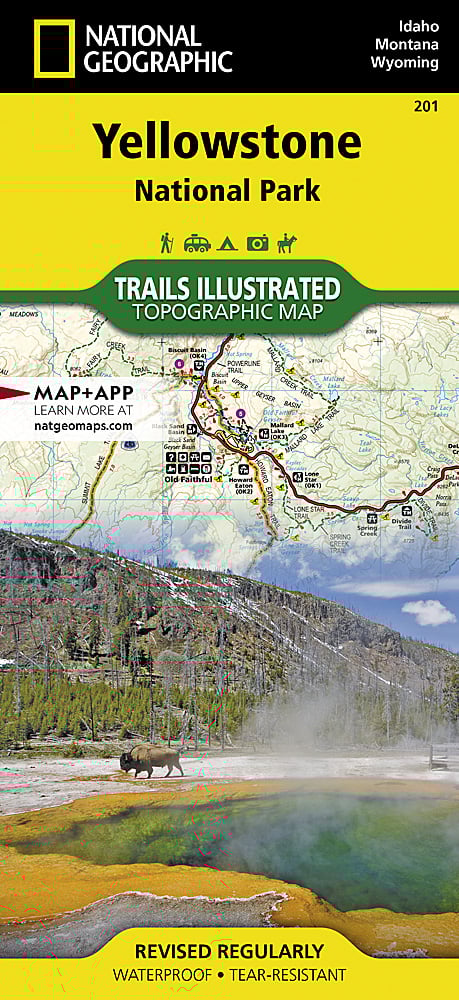
]]>THE WORLD’S FIRST NATIONAL PARK, Yellowstone was established before the states that now surround it became part of the Union. Unknown then to all but Native Americans, Yellowstone soon became a national icon. A great volcano broods beneath the world’s largest concentration of geysers and hot springs. Snowcapped mountains water a landscape of lakes, rivers, canyons, and forest, teeming with the full complement of northern Rockies wildlife.
The post Yellowstone National Park Map appeared first on MapsofWorld USA.
]]>Yellowstone is a rough rectangle measuring 50 by 60 miles draped across the Continental Divide. Seen from space, the park is a high plateau ringed by mountains. At its center lies the caldera, or collapsed crater, of a single supervolcano. The Yellowstone River flows through from the south, filling the great expanse of Yellowstone Lake before plunging into colorful canyons. Geysers, hot springs, and mud pots, found throughout the park, are concentrated most densely along a small river, the Firehole. The park’s northern section is distinct from the rest. Lower and more open, with milder winters, it is important for wildlife, particularly bison and elk.
Buy for $14.95
In winter, extreme cold, deep snow, and varied wildlife combine with geyser steam to produce a fantasy landscape of frost crystals and shifting mist. It’s beautiful, but challenging to living creatures. Spring brings renewal, as meadows turn green and newborn animals appear.
Summer is the time for growth and the fleeting bloom of wildflowers, while autumn is the season of preparation for the coming cold. In Yellowstone, winter is never far off.
The best tip for seeing wildlife and avoiding crowds is to start early in the day. Because most visitors stay close to their vehicles, you can find solitude by walking even a short distance on almost any trail.
Yellowstone’s road system forms a figure 8. Called the Grand Loop, it measures 142 miles, with spurs leading in from five entrances. At least three days are needed to sample the park. First, visit the geyser basins between Old Faithful and Mammoth Hot Springs for a day focused on thermal activity. On the second day, take a drive through the park to see such highlights as Yellowstone Lake, Hayden Valley, and the Grand Canyon of the Yellowstone for mountains and wildlife. With more time, explore the northern range, where wolves are most likely to be seen.
You can join a ranger-led guided walk for a deeper understanding; these are offered throughout the park. Note too that bicycles are permitted on some trails and can be rented in the park (nps.gov/yell/ planyourvisit/bicyling).
Yellowstone has five entrances. U.S. 20 and U.S. 191/287 lead to the west entrance. For the north entrance, follow U.S. 89 to Mammoth Hot Springs. The south entrance is reached on U.S. 89/191/ 287 through Grand Teton National Park. From the east, U.S. 14/16/20 follows the North Fork Shoshone River. The most spectacular route is open summer only. U.S. 212 climbs over 10,947-foot Beartooth Pass, to the northeast entrance.
Mid-June to Labor Day is peak season. Spring comes in gradually, with few visitors. Autumn can be spectacular, with cool nights and warm days. In midDec., the park opens for winter; oversnow vehicles only. The northern road from Gardiner to Cooke City stays open all year. Most roads and many park facilities open around mid-April and close at the end of Oct.
Of Yellowstone’s six visitor centers, only Old Faithful and Mammoth are open year-round.
P.O. Box 168 Yellowstone National Park, WY 82190 nps.gov/yell 307-344-7381
The Park Service operates seven relatively small campgrounds (first come, first served) and five large reservation campgrounds. More than 1,700 sites; check nps.gov/yell/planyourvisit/ campgrounds.htm.
Lodging is available at several locations within the park. All are seasonal; winter lodging is limited to Mammoth and Old Faithful. Lodgings can fill up a year in advance. yellowstonenationalpark lodges.com; 307-344-7311.


The post Yellowstone National Park Map appeared first on MapsofWorld USA.
]]>Wrestle Mania
Venue
Location
Date
XXXIII
Camping World Stadium
Orlando, Florida
April 2, 2017
XXXII
AT&T Stadium
Arlington, Texas
April 3, 2016
XXXI
Levi’s Stadium
Santa Clara, California
March 29, 2015
XXX
New Orleans,Louisiana
Mercedes-Benz Superdome
April 6, 2014
XXIX
MetLife Stadium
East Rutherford, New Jersey
April 7, 2013
XXVIII
Sun Life Stadium
Miami Gardens, Florida
April 1,2012
XXVII
Georgia Dome in Atlanta
Atlanta, Georgia
April 3,2011
XXVI
University of Phoenix Stadium in Phoenix
Phoenix, Arizona
March 28, 2010
XXV
Reliant Stadium
Houston, Texas
April 5,2009
XXIV
Citrus Bowl in Orlando
Orlando, Florida
March 30, 2008
XXIII
Ford [...]
The post WWE WrestleMania Games appeared first on MapsofWorld USA.
]]>
Wrestle Mania Venue |
|---|
| Wrestle Mania | Venue | Location | Date |
|---|---|---|---|
| XXXIII | Camping World Stadium | Orlando, Florida | April 2, 2017 |
| XXXII | AT&T Stadium | Arlington, Texas | April 3, 2016 |
| XXXI | Levi’s Stadium | Santa Clara, California | March 29, 2015 |
| XXX | New Orleans,Louisiana | Mercedes-Benz Superdome | April 6, 2014 |
| XXIX | MetLife Stadium | East Rutherford, New Jersey | April 7, 2013 |
| XXVIII | Sun Life Stadium | Miami Gardens, Florida | April 1,2012 |
| XXVII | Georgia Dome in Atlanta | Atlanta, Georgia | April 3,2011 |
| XXVI | University of Phoenix Stadium in Phoenix | Phoenix, Arizona | March 28, 2010 |
| XXV | Reliant Stadium | Houston, Texas | April 5,2009 |
| XXIV | Citrus Bowl in Orlando | Orlando, Florida | March 30, 2008 |
| XXIII | Ford Field | Detroit, Michigan | April 1, 2007 |
| XXII | Chicago | Chicago, Illinois | April 2, 2006 |
| XXI | Staples Center | Los Angeles California | April 3, 2005 |
| XX | Madison Square Garden | New York | March 14, 2004 |
| XIX | Safeco Field | Seattle, Washington | March 30, 2003 |
| XVIII | Skydome | Toronto, Ontario | March 17, 2002 |
| XVII | Astrodome-Houston | Houston, Texas | April 1, 2001 |
| XVI | Arrowhead Pond | Anaheim, California | April 2, 2000 |
| XV | First Union Center | Philadelphia, Pennsylvania | March 28, 1999 |
| XIV | Fleetcenter-Boston | Massachusetts | March 29, 1998 |
| XIII | Rosemont Horizon- Rosemont | Illinois | March 23, 1997 |
| XII | Arrowhead Pond | Anaheim, California | March 31, 1996 |
| XI | Civic Center | Hartford, Connecticut | April 2, 1995 |
| X | Madison Square garden | New York | March 20, 1994 |
| IX | Caesars Palace | Las Vegas, Nevada | April 4, 1993 |
| VIII | Hoosier Dome | Indianapolis, Indiana | April 5, 1992 |
| VII | Sports Arena- Los Angeles | Los Angeles, California | March 24, 1991 |
| VI | Skydome | Toronto, Ontario | April 1, 1990 |
| V | Trump Plaza | Atlantic city, New Jersey | April 2, 1989 |
| IV | Trump Plaza | Atlantic city, New Jersey | March 27, 1988 |
| III | Pontiac | Silverdome- Detroit, Michigan | March 29, 1987 |
| II | Nassau Coliseum | New York | April 02, 1986 |
| I | Madison Square Garden | New York | March 31, 1985 |
The post WWE WrestleMania Games appeared first on MapsofWorld USA.
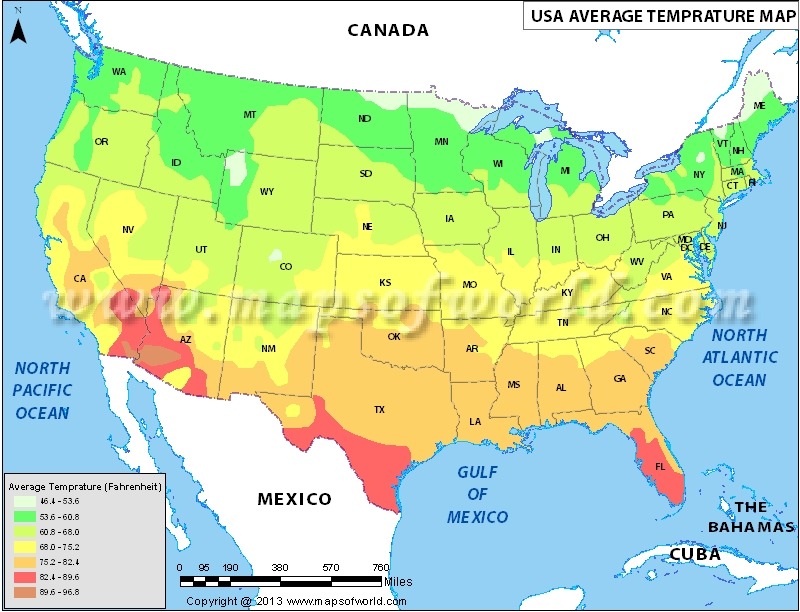
]]>Description : US Weather Map represents the average annual temperature of the United States.
Weather Map of US
Consulting with weather maps can prove to be very helpful, given the important and crucial information they provide. For instance, if you are traveling to a particular place in United States, it’s always a good idea to [...]
The post US Weather Map appeared first on MapsofWorld USA.
]]>
| Description : US Weather Map represents the average annual temperature of the United States. |
Consulting with weather maps can prove to be very helpful, given the important and crucial information they provide. For instance, if you are traveling to a particular place in United States, it’s always a good idea to check the United States Weather Maps before heading out. It will keep you one cautious step ahead, helping you in knowing whether the weather condition of your destination is all right or not.
Here, we have put together information about the United States Weather Map for you. However, if you want to find out even more, pay mapsofworld.com a visit! And, don’t think that these weather maps are static. Not at all! After every 60 hours or after a particular period of time, the map is automatically reloaded so that you get the latest news about the weather of a particular state or city in the United States.
In the United States Weather Maps, you will get ample information about the weather, such as the Zone Forecast, Forecast Discussion, Weather Summery, Hourly Report, Public Information, Climate Data and so on. There are separate weather maps for every state and city. In the map presented here, if you click on a particular place, you will find data like the visibility, sky condition, dew pint, temperature, relative humidity and pressure of that particular area.
Want to have clearer idea of these United States weather Maps? You may log on to Mapsofworld for more such interesting information on the weather condition of specific place.
The post US Weather Map appeared first on MapsofWorld USA.
]]>The post US Regions Map appeared first on MapsofWorld USA.
]]>
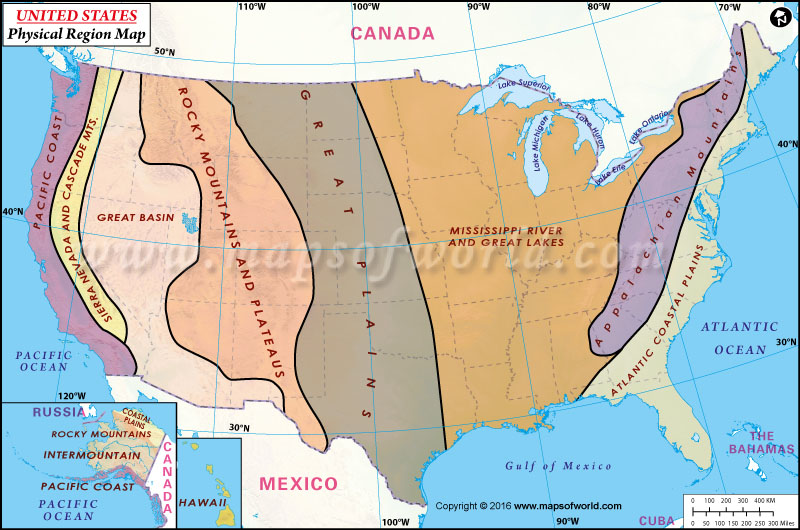
| Description : The Map showing the various physical regions of the United States. |
The United States, in the geographical sense, is commonly showed as the contiguous US which has 48 states. The states of Alaska and Hawaii are outside of the contiguous United States.
Each region has distinct culture, history, climate, and geographic features, and more.
First map of the contiguous US shows four geographic regions: the East Coast, Midwest, South, and West.
The second map depicts physical regions of the country which are: Atlantic Coastal Plains, Appalachian Mountains, Great Lakes and Great Rivers Basin, Great Plains, Rocky Mountains and Plateaus, Great Basin, Sierra Nevada and Cascades Mountains, and the Pacific Coast.
According to US Census Bureau, each of the four census regions is further divided into two or more census divisions. See table below –
ACOD~20121005
Regions of United States |
|---|
Region 1 (The Northeast) |
|
|---|---|
| Division 1 (New England) | Division 2 (Middle Atlantic) |
| Maine | New York |
| New Hampshire | Pennsylvania |
| Vermont | New Jersey |
| Massachusetts | |
| Rhode Island | |
| Connecticut | |
Region 2 (The Midwest) |
|
| Division 3 (East North Central) | Division 4 (West North Central) |
| Wisconsin | North Dakota |
| Michigan | South Dakota |
| Illinois | Nebraska |
| Indiana | Kansas |
| Ohio | Minnesota |
| Iowa | |
Region 3 (The South) |
|
| Division 5 (South Atlantic) | Division 6 (East South Central) |
| Delaware | Kentucky |
| Maryland | Tennessee |
| District of Columbia | Mississippi |
| Virginia | Alabama |
| West Virginia | |
| North Carolina | Division 7 (West South Central) |
| South Carolina | Oklahoma |
| Georgia | Texas |
| Florida | Arkansas |
| Louisiana | |
Region 4 (The West) |
|
| Division 8 (Mountain) | Division 9 (Pacific) |
| Idaho | Alaska |
| Montana | Washington |
| Wyoming | Oregon |
| Nevada | California |
| Utah | Hawaii |
| Colorado | |
| Arizona | |
| New Mexico | |
The post US Regions Map appeared first on MapsofWorld USA.
]]>The post United States Mountain Ranges Map appeared first on MapsofWorld USA.
]]>At 6,194 meters (20,320 feet) above sea level, Mount McKinley in Alaska is the tallest mountain peak in the US.
Mount Logan is the second tallest, at 5,959 meters (19,545 feet), followed by Mount Orizaba, Mount St. Elias, and Mount Popocatepetl.
The tallest mountain peak in the contiguous United States is Mount Whitney which stands at 4421 meters (14,505 feet). If you like to know about the world’s tallest mountains, check out this article: Tallest Mountains in the World.
The Rockies are a major mountain range in North America, running 3,000 miles from western Canada to the state of New Mexico. The Rockies include several subranges, including the Wasatch, Bitterroots, Big Horn, and Front Ranges. Arizona, Colorado, Idaho, Montana, Nevada, New Mexico, Utah, and Wyoming are considered Mountain States in the country.
The Appalachian Mountain Range straddle the eastern United States, stretching from Alabama, northeast across New England, and extending further up to Canada. The range is about 1,500 miles long, and traverses the US states of Maine, New Hampshire, Vermont, Massachusetts, Connecticut, New York, Pennsylvania, Maryland, Virginia, West Virginia, Ohio, Kentucky, Tennessee, New Jersey, North Carolina, South Carolina, Georgia, and Alabama. The Appalachian Range also usually includes the Blue Ridge Mountains, Great Smoky Mountains, and Allegheny Mountains.
The Cascade Range along the West Coast of the United States extend from Canada into the US states of Washington, Oregon, and California. These mountains were formed as part of the Pacific Ring of Fire, and feature volcanoes such as Mount St. Helens and Lassen.
The Sierra Nevada mountains, located in the western states of California and Nevada, are about 400 miles long. The name Sierra Nevada is Spanish for “snowy mountains,” referring to the snow-capped summits. Many of the mountains are formed of granite and shaped by glaciers.
Mountain Ranges in the US |
|---|
| Summit | State | Quadrangle2 | Date | Elevation(feet) |
|---|---|---|---|---|
| Churchhill Peaks | AK | Mount McKinley A-3 | 1954 | 20,320 |
| North Peak | AK | Mount McKinley A-3 | 1954 | 19,470 |
| South Peak | AK | Mount McKinley A-3 | 1954 | 20,320 |
| Mount St. Elias | AK | Mount St. Elias B-8 | 1985 | 18,008 |
| Mount Foraker | AK | Talkeetna D-3 | 1958 | 17,400 |
| Mount Bona | AK | McCarthy B-2 | 1959 | 16,500 |
| Mount Blackburn | AK | McCarthy C-7 | 1959 | 16,390 |
| Mount Sanford | AK | Gulkana A-1 | 1959 | 16,237 |
| Mount Vancouver | AK | Mount St. Elias A-2 | 1985 | 15,979 |
| South Buttress | AK | Mount McKinley A-2 | 1954 | 15,885 |
| Mount Churchill | AK | McCarthy B-2 | 1959 | 15,638 |
| Mount Fairweather | AK | Mount Fairweather D-5 | 1961 | 15,300 |
| Mount Hubbard | AK | Mount St. Elias B-3 | 1985 | 14,950 |
| Mount Bear | AK | McCarthy B-1 | 1959 | 14,831 |
| East Buttress | AK | Mount McKinley A-2 | 1954 | 14,730 |
| Mount Hunter | AK | Talkeetna D-3 | 1958 | 14,573 |
| Browne Tower | AK | Mount McKinley A-2 | 1954 | 14,530 |
| Mount Alverstone | AK | Mount St. Elias B-3 | 1985 | 14,500 |
| Mount Whitney | CA | Mount Whitney | 1985 | 114,494 |
| University Peak | AK | McCarthy B-3 | 1959 | 14,470 |
| Mount Elbert | CO | Mount Elbert | 1967 | 114,433 |
| Mount Massive | CO | Mount Massive | 1967 | 14,421 |
| Mount Harvard | CO | Mount Harvard | 1982 | 14,420 |
| Mount Rainier | WA | Mount Rainier West | 1971 | 14,410 |
| Mount Williamson | CA | Mount Williamson | 1984 | 14,370 |
| La Plata Peak | CO | Mount Elbert | 1967 | 14,361 |
| Blanca Peak | CO | Blanca Peak | 1967 | 14,345 |
| Uncompahgre Peak | CO | Uncompahgre Peak | 1963 | 14,309 |
| Crestone Peak | CO | Crestone Peak | 1967 | 14,294 |
| Mount Lincoln | CO | Alma | 1970 | 14,286 |
| Grays Peak | CO | Grays Peak | 1958 | 14,270 |
| Mount Antero | CO | Mount Antero | 1983 | 14,269 |
| Torreys Peak | CO | Grays Peak | 1958 | 14,267 |
| Castle Peak | CO | Hayden Peak | 1960 | 14,265 |
| Quandary Peak | CO | Breckenridge | 1970 | 14,265 |
| Mount Evans | CO | Mount Evans | 1957 | 14,264 |
| Longs Peak | CO | Longs Peak | 1961 | 14,255 |
| Mount Wilson | CO | Mount Wilson | 1953 | 14,246 |
| White Mount Peak | CA | White Mount Peak (15′) | 1962 | 14,246 |
| North Palisade | CA | North Palisade | 1982 | 14,242 |
| Mount Cameron | CO | Alma | 1970 | 14,238 |
| Mount Shavano | CO | Maysville | 1983 | 14,229 |
| Mount Belford | CO | Mount Harvard | 1982 | 14,197 |
| Mount Princeton | CO | Mount Antero | 1982 | 14,197 |
| Crestone Needle | CO | Crestone Peak | 1967 | 14,197 |
| Mount Yale | CO | Mount Harvard | 1982 | 14,196 |
| Mount Bross | CO | Alma | 1970 | 14,172 |
| Kit Carson Mountain | CO | Crestone Peak | 1967 | 14,165 |
| Mount Wrangell | AK | Gulkana A-1 | 1959 | 14,163 |
| Mount Shasta | CA | Shasta | 1986 | 14,162 |
| El Diente Peak | CO | Dolores Peak | 1953 | 14,159 |
| Point Success | WA | Mount Rainier West | 1971 | 14,158 |
| Maroon Peak | CO | Maroon Bells | 1960 | 14,156 |
| Tabeguache Peak | CO | St. Elmo | 1982 | 14,155 |
| Mount Oxford | CO | Mount Harvard | 1982 | 14,153 |
| Mount Sill | CA | North Palisade | 1982 | 14,153 |
| Mount Sneffels | CO | Mount Sneffels | 1967 | 14,150 |
| Mount Democrat | CO | Climax | 1970 | 14,148 |
| Capitol Peak | CO | Capitol Peak | 1960 | 14,130 |
| Liberty Cap | WA | Mount Rainier West | 1971 | 14,112 |
| Pikes Peak | CO | Pikes Peak | 1951 | 14,110 |
| Snowmass Mountain | CO | Snowmass Mountain | 1960 | 14,092 |
| Mount Russell | CA | Mount Whitney | 1985 | 14,088 |
| Mount Eolus | CO | Mount Whitney | 1985 | 14,083 |
| Windom Peak | CO | Columbine Pass | 1973 | 14,082 |
| Mount Columbia | CO | Mount Harvard | 1982 | 14,073 |
| Mount Augusta | AK | Mount St. Elias | 1985 | 14,070 |
| Missouri Mountain | CO | Winfield | 1982 | 14,067 |
| Humboldt Peak | CO | Crestone Peak | 1967 | 14,064 |
| Mount Bierstadt | CO | Mount Evans | 1957 | 14,060 |
| Sunlight Peak | CO | Storm King Peak | 1964 | 14,059 |
| Split Mountain | CA | Split Mountain | 1984 | 14,058 |
| Handies Peak | CO | Handies Peak | 1955 | 14,048 |
| Culebra Peak | CO | Culebra Peak | 1955 | 14,047 |
| Mount Lindsey | CO | Blanca Peak | 1967 | 14,042 |
| Ellingwood Point | CO | Blanca Peak | 1967 | 14,042 |
| Little Bear Peak | CO | Blanca Peak | 1967 | 14,037 |
| Mount Sherman | CO | Mount Sherman | 1961 | 14,036 |
| Redcloud Peak | CO | Redcloud Peak | 1964 | 14,034 |
| Mount Langley | CA | Mount Langley | 1982 | 14,026 |
| Conundrum Peak | CO | Hayden Peak | 1960 | 14,022 |
| Mount Tyndall | CA | Mount Williamson | 1984 | 14,019 |
| Pyramid Peak | CO | Maroon Bells | 1960 | 14,018 |
| Wilson Peak | CO | Mount Wilson | 1953 | 14,017 |
| Wetterhorn Peak | CO | Wetterhorn Peak | 1963 | 14,015 |
| North Maroon Peak | CO | Maroon Bells | 1960 | 14,014 |
| San Luis Peak | CO | San Luis Peak | 1986 | 14,014 |
| Mount Muir | CA | Mount Whitney | 1985 | 14,012 |
| Middle Palisade | CA | Split Mountain | 1984 | 14,012 |
| Mount of the Holy Cross | CO | Mount of the Holy Cross | 1970 | 14,005 |
| Huron Peak | CO | Winfield | 1982 | 14,003 |
| Thunderbolt Peak | CA | North Palisade | 1982 | 14,003 |
| Sunshine Peak | CO | Redcloud Peak | 1964 | 14,001 |
Source: National Geodetic Survey
The post United States Mountain Ranges Map appeared first on MapsofWorld USA.
]]>The post USA Most Populated Cities Map appeared first on MapsofWorld USA.
]]>Known as the “Big Apple,” the city of New York is home to more than 8.4 million people which is twice as more than the second largest city, Los Angeles. With over 2.7 million residents, Chicago is the largest city in the Midwestern US. A sprawling metropolis in Texas, Houston offers a blend of global appeal and Southern charm.
From Wall Street in NYC to Sunset Strip in Los Angeles, these urban areas are important financial capitals, tourist destinations, and cultural centers in the US. While Chicago is known for its up-and-coming Broadway scene, the arts district in Houston is among the largest is the US.
Take a look at the table below to know more about the largest cities in the US.
List of Most Populated Cities in US |
|---|
| State(s) | Major Cities | Population 2010 | Population 2016 (est.) |
|---|---|---|---|
| New York (NY) | New York City | 8,175,133 | 8,537,673 |
| California(CA) | Los Angeles | 3,792,621 | 3,976,322 |
| Illinois(IL) | Chicago | 2,695,598 | 2,704,958 |
| Texas(TX) | Houston | 2,099,451 | 2,303,482 |
| Pennsylvania(PA) | Philadelphia | 1,526,006 | 1,567,872 |
| Arizona(AZ) | Phoenix | 1,445,632 | 1,615,017 |
| Texas(TX) | San Antonio | 1,327,407 | 1,492,510 |
| California(CA) | San Diego | 1,307,402 | 1,406,630 |
| Texas(TX) | Dallas | 1,197,816 | 1,317,929 |
| California(CA) | San Jose | 945,942 | 1,025,350 |
| Florida(FL) | Jacksonville | 821,784 | 880,619 |
| Indiana(IN) | Indianapolis | 820,445 | 855,164 |
| California(CA) | San Francisco | 805,235 | 870,887 |
| Texas(TX) | Austin | 790,390 | 947,890 |
| Ohio(OH) | Columbus | 787,033 | 860,090 |
| Texas(TX) | Fort Worth | 741,206 | 854,113 |
| North Carolina(NC) | Charlotte | 731,424 | 842,051 |
| Michigan(MI) | Detroit | 713,777 | 672,795 |
| Texas(TX) | El Paso | 649,121 | 683,080 |
| Tennessee(TN) | Memphis | 646,889 | 652,717 |
| Maryland(MD) | Baltimore | 620,961 | 614,664 |
| Massachusetts(MA) | Boston | 617,594 | 673,184 |
| Washington(WA) | Seattle | 608,660 | 704,352 |
| Washington DC(DC) | Washington | 601,723 | 681,170 |
| Tennessee(TN) | Nashville | 601,222 | 660,388 |
| Colorado(CO) | Denver | 600,158 | 693,060 |
| Kentucky(KY) | Louisville | 597,337 | 616,261 |
| Wisconsin(WI) | Milwaukee | 594,833 | 595,047 |
| Oregon(OR) | Portland | 583,776 | 639,863 |
| Nevada(NV) | Las Vegas | 583,756 | 632,912 |
| Oklahoma(OK) | Oklahoma City | 579,999 | 638,367 |
| New Mexico(NM) | Albuquerque | 545,852 | 559,277 |
| Arizona(AZ) | Tucson | 520,116 | 530,706 |
The post USA Most Populated Cities Map appeared first on MapsofWorld USA.
]]>There [...]
The post United States Labeled Map appeared first on MapsofWorld USA.
]]>There are various kinds of labeled maps. Some of these United States Labeled Maps are only for showing the rivers, some are for showing the forests and maps are also there for showing the principal highways and roads in United States.
In the United States Labeled Maps for the rivers all the important rivers are marked. You will know all the names of the rivers and also their positions and how to get there. Similarly in the maps for forests you will get the information on the famous forests. In the highway maps you will get to see the principal roads and highways of United States.
All these labeled maps are mainly outline maps and the main areas and famous attractions are labeled. You can easily identify the places and everything.
To know more about the United States Labeled Maps and also about the other types of maps of United States, you may visit Mapsofworld. There you get the chance to see those labeled maps.
The post United States Labeled Map appeared first on MapsofWorld USA.
]]>Tourists to United States can get valuable information from these maps. Here is some key information on the United States Climate Maps. However you may also go [...]
The post United States Climate Maps appeared first on MapsofWorld USA.
]]>Tourists to United States can get valuable information from these maps. Here is some key information on the United States Climate Maps. However you may also go to the Mapsofworld for more detailed information. There you will also get to see the maps on the cities.
The climatology of the cities is described in those United States climate maps. You will have detailed information on the latitude, longitude, elevation, minimum and maximum temperature, rate of snowfall and loads of other important information.
As for example Spokane’s Latitude is 47.4 N and longitude is 117.2 W and elevation is 1922 feet, mean annual snowfall is 47.3 inches and mean annual precipitation is 16.5 inches .
Similarly in Yakima the latitude is 46.4 N, longitude is 120.3 W, elevation is 1135 feet, mean annual snowfall is 23.6 inches and mean annual precipitation is 8.0 inches . Likewise you will get the climatology of each and every city of every state in United States.
Want to know more about the United States climate maps and other maps and atlases of United States? You may visit to Mapsofworld for detailed information. There you will get to see the colorful maps.
The post United States Climate Maps appeared first on MapsofWorld USA.
]]>Latin America is a group of countries and dependencies in the Americas where Romance languages (mainly Spanish, Portuguese, Italian, and French) are predominant.
First used in 1861, the term originated in the 19th century. The region consists of twenty sovereign states and four territories that stretches from the northern border of Mexico to the southern [...]
The post Latin America Map appeared first on MapsofWorld USA.
]]>Latin America is a group of countries and dependencies in the Americas where Romance languages (mainly Spanish, Portuguese, Italian, and French) are predominant.
First used in 1861, the term originated in the 19th century. The region consists of twenty sovereign states and four territories that stretches from the northern border of Mexico to the southern tip of South America, including the Caribbean Islands.
The Geographical sub-region of the Americas, the ‘Latin America’ is a region comprising multi diverse nations and their varied cultures. This land of magnificent natural wonders, richest ecological region, and native pre-Columbian cultures, attracts millions of visitors every year.
Historically the term Latin has been used to refer to cultures with Roman influences. The Latin American region was also home to some of the earlier civilizations and empires such as Aztec, Inca, Tupi, Maya, Caribs, and Toltecs.
The earliest settlements in the Americas are of the Las Vegas Culture from about 8000 BC and 4600 BC. With the arrival of the European explorers, the indigenous empires such as the Incas and Aztecs were defeated by the invasion. European culture, customs, religion, and government were introduced.
Many Latin American countries sought freedom from colonization in the 19th Century.
Latin America covers a total area of 7,412,000 square miles (19,197,000 sq. km.) with a population of about 626,741,000, as per 2015 estimate.
The time zones of the entire region range from UTC 2 to UTC 8.
Mexico City is the largest city in Latin America followed by São Paulo and Buenos Aires. Other major cities are Rio de Janeiro, Lima, Bogotá, Santiago, and Caracas.
The region is known for its abundant ecological diversity. The world’s greatest ecosystem, the Amazon Rainforest, and world’s largest wetlands, the Pantanal are located in Latin America.
The Amazon basin, the world’s largest river basin, spans nearly seven Latin American nations.
Spanish and Portuguese are the two widely spoken languages of Latin America.
Almost 90% of people in Latin Americans are Christians.
Brazil, Mexico, Colombia, Argentina, and Peru are five largest countries in Latin America.
Eighty percent of the population in Latin America resides in urban areas.
The Amazon rainforest generates more than 20% of the world’s oxygen.
Costa Rica does not officially have a military.
WBGM14102014
The post Latin America Map appeared first on MapsofWorld USA.
]]>